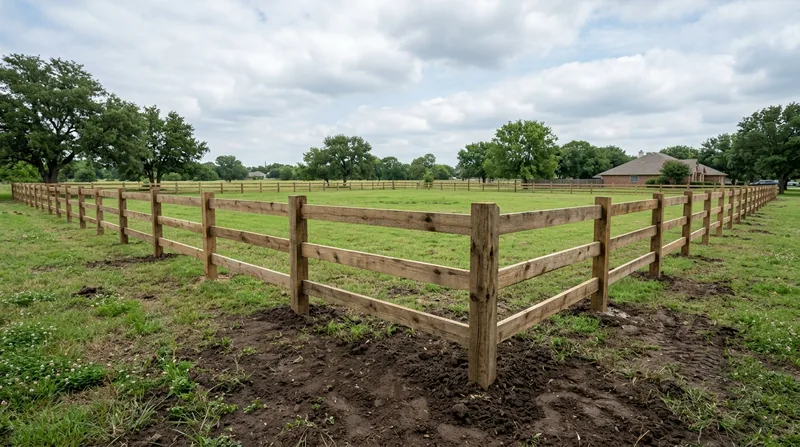




Arlington and the surrounding Mid-Cities sit on the gently rolling Blackland Prairie, where acreage and rural residential properties demand serious fencing infrastructure. Whether you're running livestock on a few acres in Mansfield, securing a working ranch near Grand Prairie, or protecting pasture and equipment on the outskirts of Arlington proper, farm fence installation in Arlington requires materials and methods built for long runs, deep post sets, and the heavy clay soil that swells after spring rain and cracks hard in summer drought. We install ranch rail, no-climb horse fence, field wire, and pipe fencing across Greater Arlington with straight lines over distance, properly braced corners, and gates sized for trailers and equipment. Since 2015, we've worked the terrain and weather of North Texas acreage, and we understand what holds when the ground shifts and what fails when corners aren't reinforced or posts aren't set deep enough in expansive soil.
Why Farm and Ranch Fencing Matters in Arlington Acreage
Acreage in and around Arlington faces real fencing challenges. The Blackland Prairie clay swells significantly after spring rain and shrinks hard in summer, putting lateral stress on fence posts and rails. Livestock, equipment, and property boundaries demand fencing that won't sag, twist, or fail under seasonal ground movement. A fence installed on tamped soil alone will rack and shift within a year or two. Posts set shallow or in poor concrete will heave upward or lean as the clay cycles. Corners without proper bracing will collapse under tension from livestock or high wind during North Texas spring storms.
- We set posts 3 to 4 feet deep in concrete to anchor them below the frost line and seasonal clay movement.
- We brace all corners with diagonal anti-sag bracing to handle tension and lateral stress over long runs.
- We space posts and rails to handle livestock pressure and the weight of field wire or no-climb mesh without sagging or twisting.
- We size and install gates for equipment and trailer access, with hinges and hardware rated for daily use and weather exposure.
- We work from existing property lines you identify or from a survey you provide, ensuring the fence sits where it belongs.
Proper farm fencing holds its line through seasonal ground movement, livestock pressure, and North Texas weather.
Key info: Acreage properties in the Arlington area often sit on the edge of city limits or in unincorporated county land. Fence height, material, and setback rules vary between Arlington city, Arlington County, and neighboring jurisdictions like Mansfield, Grand Prairie, and Euless. Check with your local building department or county extension office before ordering materials. We work from the setback and height rules your jurisdiction sets, and we install on the line you identify.
How We Install Farm and Ranch Fencing in Arlington: The Process
Farm fencing on acreage demands a systematic approach. We start with a site walk to understand terrain, soil type, livestock or equipment needs, and gate placement. We call 811 for a utility locate to mark underground lines before we dig any post holes. We then set posts at proper spacing and depth, brace corners, and install rails, wire, or pipe to your specifications. Every step accounts for the clay soil and weather swings that dominate the Arlington area.
- We obtain or verify the utility locate at no charge, because Texas law requires it before we break ground.
- We mark post locations to maintain proper spacing for the fence type and load you need.
- We dig post holes 3 to 4 feet deep and set posts in concrete to resist seasonal heave and shift in expansive clay.
- We install anti-sag bracing at corners and long spans to handle tension from livestock, equipment, or wind.
- We attach rails, field wire, no-climb mesh, or pipe to posts with galvanized or stainless fasteners rated for outdoor exposure.
- We hang and set gates on heavy-duty hinges with self-closing or self-latching hardware if you choose it.
This method ensures your fence holds its line through seasonal clay movement and years of use.
Example: A 5-acre pasture property near Mansfield with a 400-foot perimeter needs 12 posts at 33-foot spacing, four corners braced with diagonal anti-sag bracing, a 10-foot equipment gate, and no-climb horse fence. We set posts 4 feet deep in concrete, brace each corner, install the mesh, hang the gate on commercial hinges, and test every latch and hinge before we leave. The job runs 5 to 7 days depending on soil hardness and weather, and holds through the summer drought and spring clay swell that follows.
For more on gate installation and hardware options, visit our gates page.
Fencing Methods for Farm and Ranch Use in Arlington
| Approach | Description | Best For |
|---|---|---|
| Ranch Rail | Pressure-treated pine or cedar rails mortised into posts, typically 2x6 or 2x8 on 4x4 posts, installed with 2 or 3 rails per span. | Pasture boundaries, horse properties, visual appeal, and moderate livestock containment. |
| No-Climb Horse Fence | Rigid welded wire mesh (typically 2x4 or 2x6 inch openings) attached to posts with no horizontal rails that a horse can grip or climb. | Horse pastures, paddocks, and small livestock where safety and visibility are priorities. |
| Field Wire and Barbed Wire | High-tensile or standard barbed wire strung between posts on insulators or stapled directly, with 3 to 5 strands depending on livestock type. | Cattle, sheep, and goat pastures, large acreage, and cost-conscious boundary fencing. |
| Pipe Fencing | Steel or galvanized pipe welded or bolted into post frames, typically 2 to 3 rails per span, with high structural strength and longevity. | High-traffic areas, equipment enclosures, corrals, and heavy-use working properties. |
| Split Rail | Hand-split or sawn cedar or pressure-treated rails laid in post-and-rail construction, rustic appearance with modest containment strength. | Decorative boundaries, rural aesthetics, and low-pressure fencing where visual character matters more than livestock security. |
Each method handles the Arlington climate and soil differently. Ranch rail and split rail suit horse and small-acreage properties where appearance and moderate containment are the goal. No-climb mesh provides security for horses without the climbing hazard of horizontal rails. Field wire and barbed wire cover large acreage economically and hold cattle and sheep reliably. Pipe fencing delivers maximum durability and strength for working properties and high-traffic areas. We help you choose based on your livestock type, acreage size, budget, and how long you plan to own the property.
Farm and Ranch Fencing Cost in Arlington: What to Expect
Farm and ranch fencing cost in Arlington runs from $12 per linear foot for basic field wire on well-spaced posts to $25 to $35 per foot for no-climb horse fence with proper bracing, and $30 to $45 per foot for pipe fencing with welded frames. Ranch rail sits in the middle at $18 to $28 per foot depending on rail size and post spacing. A 400-foot perimeter pasture with no-climb mesh and braced corners typically costs $4,800 to $7,200 before gates. A half-mile working property with field wire and equipment gates runs $3,000 to $6,000 depending on terrain and gate count.
Cost depends on several real factors. Posts set 4 feet deep in concrete cost more than tamped posts, but they hold through seasonal clay movement and outlast shallow installations by years. Corners with anti-sag bracing cost more upfront but prevent sagging and failure. Long runs without obstacles cost less per foot than properties with trees, rocks, or steep terrain that slow digging and installation. Gates add $400 to $1,200 each depending on size and hardware. Access to your property and soil hardness also affect labor time and price.
Get 2 or 3 estimates from contractors who understand North Texas soil and climate. A low bid that skips concrete post setting or corner bracing will fail in 2 to 3 years. A solid estimate explains what you're paying for: post depth, concrete, bracing, materials, and labor over the job timeline. We provide detailed pricing and examples on our pricing page, and we give free estimates with no obligation to book.
Hiring a Farm and Ranch Fencing Contractor Near Me: What to Look For
When you're choosing a contractor for acreage fencing near Arlington, several things matter. First, confirm they are fully insured with general liability and workers' compensation cover, and ask for a certificate of insurance. Second, understand that Texas does not issue a state contractor license for fence installation, so fence licensing here is set county by county and varies across the jurisdictions in Greater Arlington. Ask your local building department or county extension office what permitting rules apply to your property. Third, get multiple estimates and ask each contractor how they handle post setting depth, corner bracing, and seasonal ground movement in clay soil. Fourth, ask for references from recent farm and ranch projects in the Arlington area, and contact at least two to ask about post holding, corner stability, and how the fence has held through a spring rain cycle and summer drought.
- Verify full insurance coverage with a certificate of insurance provided before work starts.
- Confirm that your local jurisdiction does or does not require a fence permit, and ask the contractor if they pull it or if you do.
- Ask how the contractor sets posts in concrete, what depth they dig, and how they handle bracing on long runs and corners.
- Request references from acreage properties in Arlington, Mansfield, or Grand Prairie, and call them to ask about post stability and corner performance.
- Get a written estimate that lists post spacing, concrete depth, materials, bracing details, gate count and size, and timeline.
- Understand that we are an AFA Member Installer and have been in business since 2015, and we bring experience with North Texas clay soil and seasonal ground movement.
A contractor who understands clay soil, braces corners, and sets posts deep will deliver a fence that holds. Call us at (682) 277-0410 or request a free estimate online to discuss your acreage and get a realistic price.
Farm & Ranch Fencing in Arlington: Pricing Guide
| Service | Price | Details |
|---|---|---|
| Field Wire Fencing | Starting at $12/ft | Barbed wire or field wire on posts, standard spacing, best for large acreage and cattle containment |
| Ranch Rail Fencing | Starting at $18/ft | Pressure-treated or cedar rails mortised into posts, includes anti-sag bracing at corners and proper post depth |
| No-Climb Horse Fence | Starting at $25/ft | Welded wire mesh on posts with corner bracing, includes concrete post sets and hardware for livestock security |
| Pipe Fencing | Starting at $30/ft | Galvanized or steel pipe welded or bolted to posts, maximum durability for working properties and corrals |
| Equipment Gates | $400-$1,200 each | Hinges, latches, and hardware sized for trailers and equipment, self-closing or self-latching options available |
| Free Estimate | No obligation | Site visit, materials review, and written estimate within 24 hours at (682) 277-0410 |
Indicative pricing, the exact cost depends on square footage, finish, and site access. Free personalized estimate within 24h at (682) 277-0410.


